Friday, August 14, 2009

Wednesday, August 5, 2009
Towards Food Security


Currently ADRA Malawi as a member of JEFAP consortium is the lead NGO in Phalombe District which is one of the flood prone areas in the southern part of Malawi. ADRA is implementing a WFP funded program in emergency and relief operation. It is a three year program which started in Jan.08 and will finish in Dec.2010.
This program is targeting 5099 beneficiaries.

Under this program there are three components namely, Food For Work, HIV/AIDS and Sustainable Livelihood Interventions.
Food For Work activities targets able bodied households with food insecurity and beneficiaries are asked to create assets for the benefit of the community like fish ponds and irrigation dams, in return they receive a monthly ration of food items. HIV/AIDS activities target households with food insecurity and are keeping chronically ill patients or orphans. On this program beneficiaries receives a monthly ration of food items with no work for it. Unlike in the food for work.
Sustainable Livelihood Intervention (SLI) program targets HIV beneficiaries. They are supplied with small scale livestock like goats and poultry and bakery ovens for IGA as an exit strategy to the HIV program. The out of school orphans are provided with vocational training skills like carpentry, tinsmith and tailoring with start up kits as a capital for their IGAs.
These programs have had a lot of impact on the beneficiaries and community as a whole. It has improved nutrition status in the communities as verified by the nutrition survey recently conducted by MoH in the district. The food distribution has saved 5099 families from hunger and absolute poverty. This means that 25000 people have been provided with daily food rations and saved from hunger. There has been a great reduction on male migration from Phalombe to Mozambique for search of food. Development at community and house hold levels has been enhanced since people’s migration has been reduced and sale of asserts by families has been reduced.
Author: Hastings Lacha - ADRA Malawi Emergency Preparedness and Relief Coordinator
Monday, August 3, 2009
Towards a Better Future

Yankho Konyani, ADRA M&E Assistant with the Tiyambe IGA Group
The group is very happy with the initiative because they have already planned that 40% of their profit will go to the orphans, the elderly, the chronically ill and the poor. Their vision is to see vulnerable groups benefit through having enough food, medicine, good education, clothes, soap and shelter. They are convinced their community will no longer be the same and this is all thanks to ADRA for providing not just the capital and tools for the business, but hope and empowerment to provide assistance in their own community. This marks the beginning of a vibrant business and a better life for the community with more updates as progress arises from the business.
By Yankho Konyani and Kerryn Lodo
------------------------------------------------------------------------------------------
[1] UNAIDS 2008 Report on the Global AIDS epidemic. Retrieved on the 29/7/2009 from http://www.unaids.org/en/KnowledgeCentre/HIVData/GlobalReport/2008/
[2] Ministry of Health and Population, Malawi (2004), ‘Treatment of AIDS, the two year plan to scale up antiretroviral therapy in Malawi’. Retrieved on 28/7/2009 from http://www.avert.org/aids-malawi.htm
Wednesday, July 29, 2009
Community decided that this was unacceptable practice...
Before the introduction of the ADRA LEFAM program, it was common to find children in areas of Malawi working in tobacco fields earning less than $5 a month. Often children were encouraged with offers of good jobs and enough income to support their families but were forced to work as free labour with only limited food and shelter in return. One report on child labour done by the ILO (International Labour Office), a branch of the UN, reported that in 2007, approximately 23.3% of children in Malawi participate in some form of labour.
Through the LEFAM program ADRA empowers individuals and communities to discuss the issues which are affecting them and through that dialogue find solutions to bring about the change that they themselves want. There is also an aspect of education on human rights, including that of children, and what their relevance is to each community. In one community, when they identified the practice of child labour as inhumane, the rights of children to safety, education and to be with family were discussed and used to further emphasise the impact of such activity.
With this combination of community dialogue and the human rights trainings the community decided that this was unacceptable practice and resolved to discourage those participating in it. The community bought this issue to the traditional leaders and together approached the offending farmers, informing them of the implications of their practice to employ children. Over a period of time, with the influence of the traditional leaders and pressure from community members, these farmers no longer engaged children in labour but are now employing men from the area and providing full remuneration for their work. Currently child labour, while not completely eliminated from this area, has been greatly reduced and together the community has seen major changes in attitudes and practice.
This is just one example of the impact of community dialogue sessions being implemented by ADRA LEFAM and the wide spread changes which can come when individuals work together as a community to try and implement change. ADRA aims not to solve the problems within a community but to empower communities to identify which issues they would like to change and give them the tools to do this that long after ADRA this process will still be taking place and communities working together to bring about positive change.
Author: Kerryn Lodo
Monday, July 27, 2009
Applying the knowledge gained
This is a story about Mrs Nolia Ngwangwa, a 65 year old woman of Simon village, Traditional Authority Simon in Neno District.
Mrs. Nolia Ngwangwa has this year harvested 40 bags of maize and 14 bags of groundnuts. The secret behind her success is that she applies manure in her garden. She says manure is good for dry soils. With manure, the soil still retains some moisture. She was taught how to make manure by ADRA-Integrated Health and Food Security Project in 2006 and since then, she has been harvesting more than she used to do. Comparatively, she is also harvesting more than some farmers who are not applying manure.
Last year, when others harvested very little or nothing at all, she managed to harvest 20 bags of maize. She also does experiments in her garden. One area of the garden she applies with manure and the other half, she doesn’t. She harvests twice more in the area applied with manure. This has encouraged her to increase the area under manure every year and she hopes to be able to apply manure in the whole garden.
With sales from agricultural produce, she is able to pay school fees for her grand children, she has bought 2 goats and household utensils.

As I was passing through the village last week, I found her cutting maize stalks from last harvest into small pieces and this is how she makes manure: 3 pails of chopped maize stalks mixed with 3 pails of dark soil collected from a tree shed mixed with 3 pails of animal manure and half pail of ashes. The stuff is then mixed with water until the mixture gets stiff and she makes heap. After 4 months, the heap is well decomposed and ready for application. With one heap, she can apply up to 0.25 of a hectare.
Author: Moses Mpezeni - Monitoring and Evaluation Officer (ADRA Malawi)
Wednesday, July 22, 2009
New beds to Malamulo Hospital

The project was initiated after an evaluation of the hospital was done by the ADRA Malawi Country Director and the Malamulo Hospital Management Team. The evaluation was done after it was realized that many of the 275 hospital beds were of poor design and in bad condition.
This evaluation revealed that close to 100 beds were indeed in very bad shape and needed to be replaced. This led to designing of the project and sourcing of the beds through ADRA International in the
Customs clearing was done and the beds were delivered to Malamulo Hospital on 12th & 14th March 2009. A total of 94 beds and 92 mattresses were received and delivered. They were delivered by the ADRA Malawi Logistics & Procurement Officer and received on behalf of the hospital by the hospital Adminsitration.
At the moment the beds have been distributed in the General ward (Male & Female), Private wards, Maternity ward and Annex ward where they are being used by patients (See picture).
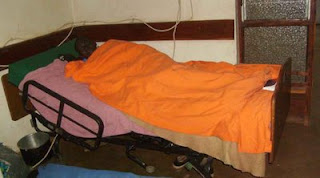
The hospital management is very appreciative of the donation which they said has enabled them to replace the old beds (mentioned earlier) which were in bad shape and of poor design. This donation they said has done a lot to improve the facilities at the hospital as well as the general outlook.
When interviewed, the patients also expressed appreciation for the new beds which they said were more comfortable and convenient. This they said was mainly due to the new mattresses and the mechanism for adjusting the level of the head and legs. This they said has enabled them to make adjustments to suit the needs of the patient and make them more comfortable.
Author: Dyson Mbengo
Friday, July 17, 2009
The Kalumba Food Security Project Impact
Recently, on a visit to the Kalumba Food Security Project in Lilongwe I had a chance of learning more about the project. The project area is located in the Central Region of Malawi in Lilongwe District.
It has been running now for the past 3 years, with funding from ADRA Canada, and will be coming to an end on 31st July 2009. It targets a total of about 231 villages under the Kalumba Traditional Authority with a total over 600 households. The aim of the project is to mitigate the effects of hunger in this hunger prone area.

Various interventions were carried out in order to mitigate the effects of hunger which was a chronic problem in the area. The first step was to establish farmers clubs through which the various activities would be implemented. Thus a total of 21 farmers clubs were formed which are active up to this day. The other core interventions included actual Food Distribution, Dissemination of knowledge on new Farming Techniques, giving out of Farm Inputs and Implements, teaching the community about Nutrition, digging of Water Wells and finally the installation of a Maize Mill.
During the visit several focus group discussions were held to get a feel of how the project has impacted the area as well as how the Maize Mill is being managed and what benefits the community is realizing from it. From the discussions the community is benefiting as follows:
- Maize mill:
- They have a mill nearby as compared to earlier times when they had to travel/walk long distances (over 12 kilometers) to get to one.
- Those to whom the maize mill is still too far, have an alternative facility when there’s a power black out.
- Other’s have obtained employment from the mill
- The mill is slowly increasing economic activity at the small trading centre which was earlier less patronized by the community.
- Modern farming methods. They have learnt new methods of farming which are helping them to harvest more than before e.g. Sasakawa method of planting, manure making, seed selection, food storage techniques, ridge spacing.
- Actual food distribution. At a time when the food crisis had reached a peak, maize, beans and ground nuts were distributed to the community to mitigate the effects of hunger.
- Goat rearing. This they said has benefited them a lot as up to now more than 50% of households in the area still have the goats.
- Potable water. A total of 21 wells have been dug from which they are drawing better quality potable water than was the case before.
- Health & Nutrition. The community has also acquired knowledge on various aspects of health especially about the HIV/AIDS pandemic as well as on nutrition. They have also learnt how to produce vegetables from the dambos and kitchen gardens.
- Farm implements and inputs. They received farm implements (e.g.hoes) and other inputs (e.g. maize, g/nuts and vegetable seeds) to help them in their farming work.
- Community spirit enhanced. The community feels the project activities have improved their oneness.
- Reforestation. Almost every household in the area has cassia trees which have been planted under the project. These are fast growing trees which are providing shelter and are a source of wood and timber.
However despite all the benefits obtained from the project, there were some problems which were observed. Some of them are :
- Weak Business Management knowledge. It was observed that the level of Business Management knowledge was low. There’s need to give the committee and other key leaders more training in this area.
- Potable water. Although 21 wells have been dug through the project, it would be better if several proper boreholes were provided to the area to further improve the quality of water.
In conclusion:
On the whole, the area has benefited significantly from the project and the community is concerned that ADRA is leaving; however understanding that all projects come to an end, the community members said that ADRA should still visit them once in a while just to check on them and give them encouragement.

The promise of continued visits from ADRA was made and will be kept as the relation that ADRA Malawi develops with the communities is more than a work related partnership but rather a partnership based on accountability, trust and friendship that prevails long after the project ends. As an example of a continued concern, even as the project relationship is phasing out, further efforts to respond to the 2 main problems identified has been initiated. In collaboration with the donor of the project that is phasing out, ADRA Canada, it was possible to respond positively to the water problem and two boreholes will be drilled in the area.
